Custom-Coded
Websites engineered from scratch, no page builder, no template. Every animation, every interaction and every line of code is intentional, which makes these the fastest and most distinctive sites we build.
Vertex Digital
A scroll-cinematic agency site: the page unfolds like a film sequence while you scroll, driven by a frame-scrubbed hero and buttery smooth motion.

Orion Labs
A business onepage as a living JARVIS command deck: instrument panels, radar sweeps and a neural sphere, every panel opening into a real service page.

Universum
A journey through space controlled by your scroll: Earth, a nebula and a black hole rendered as frame-by-frame film sequences in a single elegant page.
Verdanta
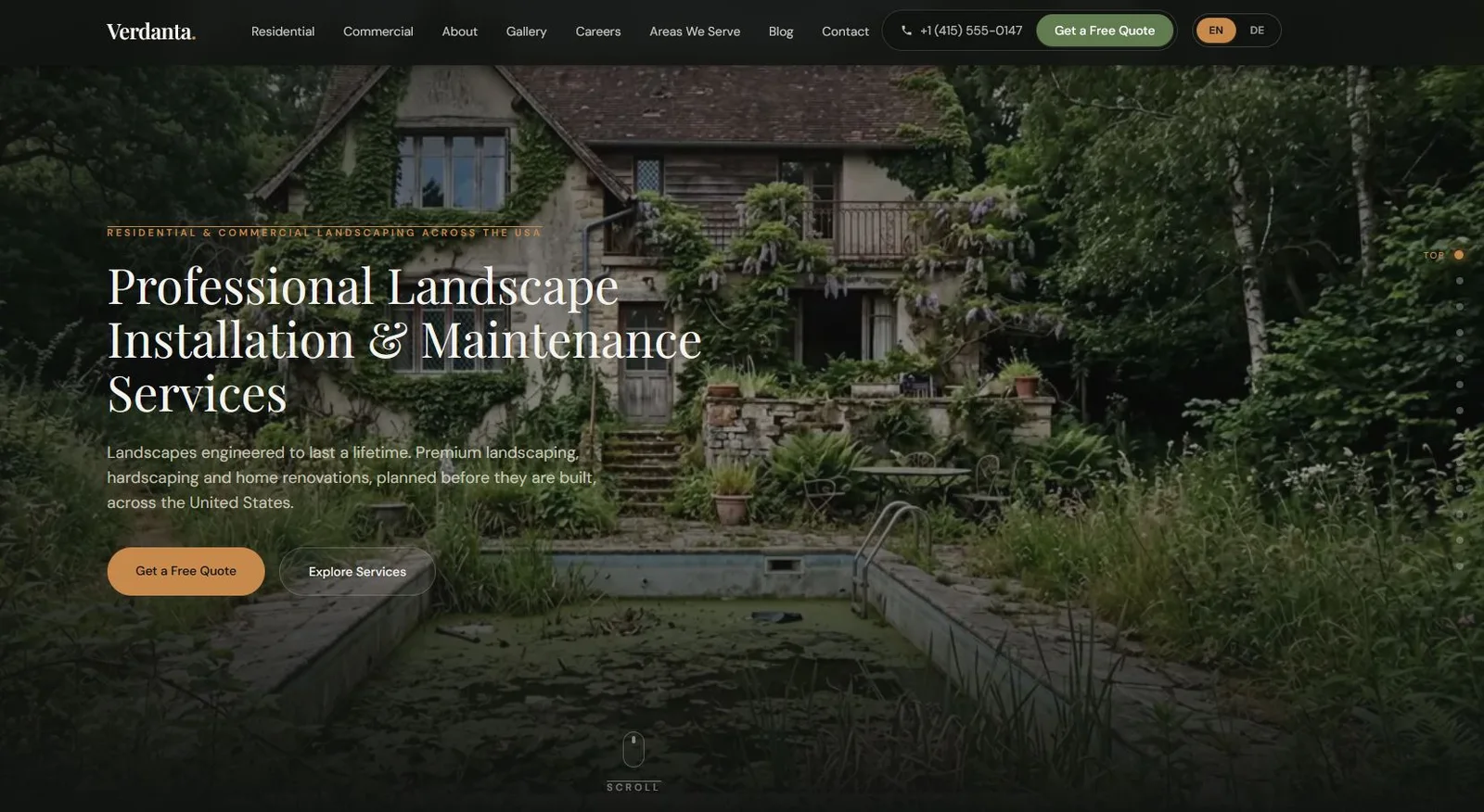
A warm, trust-first site for a landscaping business: organic tones, calm motion and an interactive service-area map that makes it feel local.
Frequently asked questions
Answers to the questions we hear most often.
A custom-coded website is built from scratch in code rather than assembled from a template or page builder.
Instead of adapting a pre-made theme, every layout, animation and interaction is written specifically for your project. This gives full control over performance, design and functionality, which is why custom-coded sites are usually the fastest, most distinctive and most flexible option, at the cost of more time and budget than a template.
A template or page builder gives you speed and low cost from a shared layout; custom code gives you originality, speed and flexibility built specifically for you.
Builders like generic themes are great for getting online quickly and cheaply, but they carry extra code, shared designs and limits you eventually hit. Custom-coded sites ship only what they need, so they load faster, look unique and can do exactly what your business requires. The trade-off is a higher upfront investment and a longer build.
Hand-coded websites are faster because they ship only the code the page actually needs, without the extra weight of templates and plugins.
Template systems load styles and scripts for features you may never use, which slows down loading and interaction. A custom build sends lean HTML, optimized images and minimal JavaScript, so it hits strong Core Web Vitals more easily. Faster pages improve both user experience and SEO, since speed is a real ranking and conversion factor.
Custom website design is worth it when performance, brand differentiation or specific functionality matter to your results, which is often the case for growing businesses.
If you only need a simple presence, a good template can be enough. But if your site is a core sales channel, the speed, originality and flexibility of a custom build usually pay back through better conversions, easier scaling and lower long-term friction. The right choice depends on how much your website contributes to revenue.
Yes. A custom-coded site can be paired with a lightweight content editor so you can update text, images and pages without touching code.
Custom does not have to mean dependent on a developer for every change. We can connect the parts you need to edit to a simple admin or headless CMS, while keeping the performance benefits of a hand-built front end. What stays fixed versus editable is decided up front based on how you plan to maintain the site.
Custom builds here use modern frameworks such as Next.js and Astro, with the stack chosen to fit each project rather than forced on it.
These tools allow server-side rendering and static generation, which keep pages fast and SEO-friendly while still supporting rich interactions. For content-heavy sites we lean toward Astro, for highly interactive apps toward Next.js, and we add only the libraries a project genuinely needs to keep the result lean and maintainable.
A custom-coded website gives you a strong technical SEO foundation, because you control speed, structure, markup and rendering directly.
Good SEO still depends on content, relevance and authority, but custom builds make the technical side easier: fast Core Web Vitals, clean semantic HTML, proper canonical and schema markup, and server-side rendering so search engines and AI systems can read every page. Templates can rank well too, yet they often carry bloat that you have to fight against.
Custom-coded websites suit brands that need speed, a distinctive design or specific features, and treat their site as a serious business asset.
They are a strong fit for companies competing on brand, sites with unusual requirements, and anyone who has outgrown a template. If your needs are simple and budget is tight, a well-built template may serve you better for now, and you can move to custom later as the site becomes more central to your growth.